
A lightweight match-up. Canon QS-300 versus Sharp QL-310, two portable typewriters circa the mid 1990s.


Canon serial numbers do not appear to be Year/Month coded, but advertising suggests its QS (50, 100, 110, 200, 210, 300, 310, 700) series of portables were first released in 1995. The Canon “QS” prefix stands for “Quiet Sensation”.

Sharp serial numbers suggest that its QL (100, 110, 110L, 200, 210, 300, 310) series of typewriters were manufactured between 1994 and 1998 and this is backed up by advertising.

It’s not clear what the “QL” prefix stands for (unlike earlier PA “Personal Automation” series portables), however the QL prefix seems to have been first used in the USA for “Celebra” QL-825, QL-855 variants of the PA-3130 and PA-3140, two portable typewriters first released in 1987.

Design
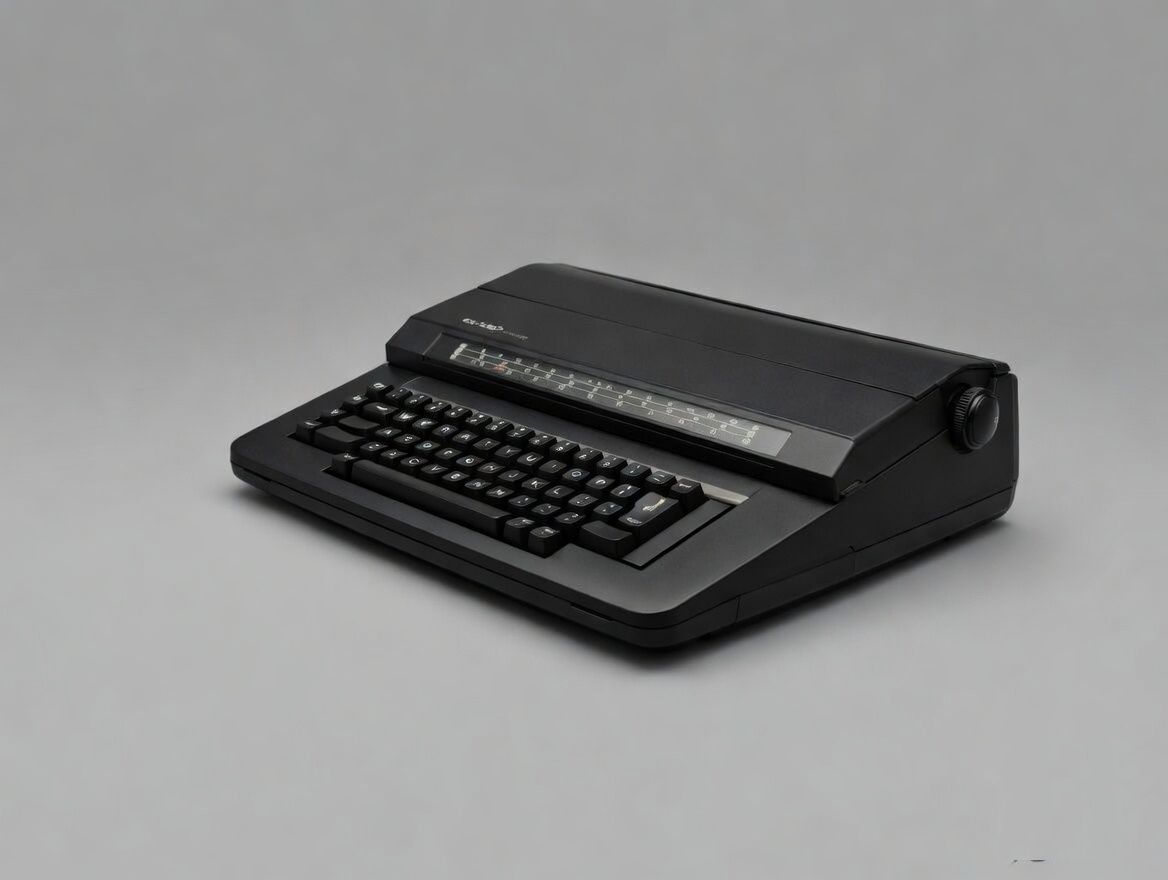
In terms of aesthetic appeal, the simplicity and the low-gloss, mid-grey colouring of the Sharp QL-310 and its darker key caps is much more pleasing to the eye and the camera lens.


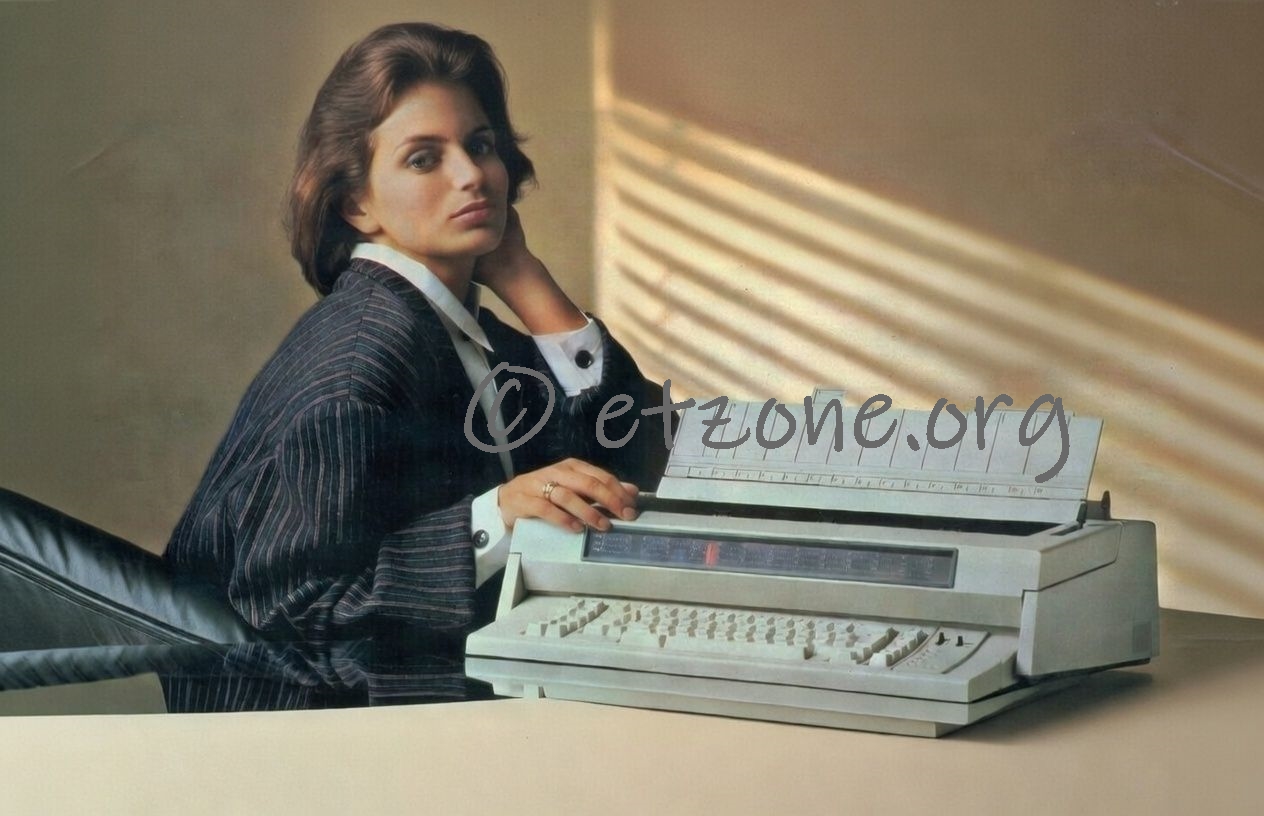
Compare that with the bland, cream-beige colour scheme of the Canon QS-300 and its matte-finish, which is very vulnerable to yellowing (should you expose its ABS plastic to sunlight).

As well as having a similar prefix and model numbering scheme, the Canon QS-300 and the Sharp QL-310 have a similarly-rounded outer shell with what might best be described as a transparent ribbon cover (Canon refer to it as a “noise shield”, while Sharp refer to it as a “top cover”). Both covers can be pulled forward to gain access to the print unit.

The “top cover” on the Sharp QL-310 lifts all the way back, so that it sits precariously over the keyboard. Any accidental downward pressure would likely cause a lot of damage. Better to be on the safe side and just lift it out, which is easy to do.

The more substantial “noise shield” on the Canon QS-300 can only be moved into a semi-upright position (better design) and can also be lifted out.

In terms of functional design, an obvious similarity between these two typewriters is the use of colour-coded Code and Mode keys.

But who came up with the idea first?

Initially manufactured in Japan and Korea in 1986 and then later in Bretagne, France, the Canon S-68 (below) was the first Canon typewriter to have colour-coded Code and Mode function keys (the lower-spec S-58 just has a yellow Code key).

In the case of Sharp, colour-coded Code and Mode function keys first appeared in its later PA series of Sharp portables released from 1989 onwards.

So the evidence suggests Sharp copied Canon’s example.

Build Quality
As with the outer shell, the smaller mid-grey keyboard/LCD cover of the Sharp QL-310 is more attractive than the larger keyboard/LCD cover of the Canon QS-300.

However, you can’t help worrying that its hooks and tabs are prone to breakage, should you inadvertently move the cover sideways while lifting off the cover.

The simpler keyboard/LCD cover on the Canon QS-300 is made of a more flexible ABS plastic.

It’s more robust, at the cost of being about as attractive as a plastic dust pan. Unfortunately, the outer shell, keyboard cover and platen knobs of the QS-300 are all made of the same low-grade (matte on the outside) ABS plastic.

Looking under the ribbon cover of the Sharp QL-310, its all-plastic print unit would not look out of place under the ribbon cover of a Mehano toy typewriter.

Such was the state of low-cost typewriter manufacturing towards the end of the electronic typewriter era.
The Canon QS-300 print unit is much more substantial. A solid metallic tube that supports the sub-frame (that the fragile Sharp QL-310 doesn’t have) is evident.


Technical Specification
The feature-packed Sharp QL-310 boasts a 62 page instruction guide, while the Canon QS-300 instruction guide (at 34 pages) is almost half the size.
Bear in mind though, that the dual pitch QS-300 is a mid-range model, while the triple-pitch Sharp QL-310 is top of its range.
In that respect, a technical comparison is a little skewed in favour of the Sharp QL-310, which offers a two line automatic correction memory and a 20 character LCD screen (compared to the single line memory and 16 character LCD screen of the Canon QS-300).
The Sharp QL-310 has the edge in every respect except print speed and noise emission. However, these are two very important metrics and Canon set a high 14 cps print speed benchmark for its portable models that none of its rivals were able to match.
Usability
Canon’s “Quiet Sensation” lives up to its name, whereas the 12 cps Sharp QL-310 is comparatively noisy (without being annoyingly so).
When it comes to usability, the Canon QS-300 wins this contest hands down, being faster, quieter and with the more spacious keyboard.
When it comes to the availability of ribbons, both typewriters seem to be on a par. Their respective ribbon cassettes are still widely available but perhaps slightly harder to find than say, Brother or Nakajima All ribbons.


Finding printwheels, especially New Old Stock (NOS) ones, is becoming a problem across all brands.


Both these typewriters take a proprietary 96 character non-cassette printwheel – a format that Canon stuck with across all categories and models, whereas Sharp ditched the better quality cassette wheels it used in earlier PA series models.

Collectability
Neither model is particularly collectable, but since the Sharp QL-310 is more attractive, “top-of-its-range” and (as far as I know) the last portable model that Sharp produced, its a slightly more interesting example to own.
Not much between the two, the Sharp QL-310 is let down by its shoddier build quality, the Canon QS-300 is let down by its anaemic design.
A hybrid of the two would be just great!
Sharp 6.5 out of 10 (D=1.5, B=1, T=2, U=1, C=1)
Canon 7 out of 10 (D=1, B=2, T=1, U=2, C=1)
You must be logged in to post a comment.